



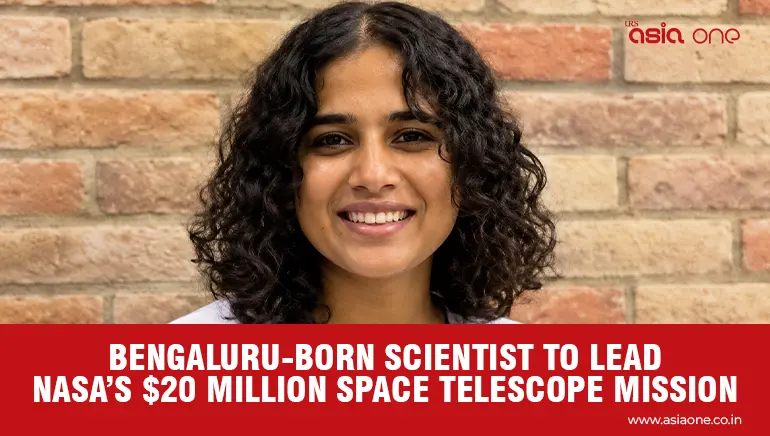
Bengaluru-born astronomer Ramya Manjunath Anche has been selected to lead NASA’s PUFFINS space telescope mission, a $20 million project designed to investigate the properties of interstellar dust.
Anche, an assistant research professor at the University of Arizona’s Steward Observatory, will serve as principal investigator for the mission. PUFFINS stands for Polarimetry in the Ultraviolet to Find Features in Interstellar Dust. It has been selected through NASA’s Astrophysics Pioneers programme, which supports smaller, cost-capped missions designed to address important questions in astronomy.
The mission is intended to help scientists understand how tiny grains of dust in space form and evolve. These particles play an important role in the creation of stars and planets, yet their properties and origins remain incompletely understood.
PUFFINS will use a small satellite carrying a telescope with an aperture of about 10 inches. The instrument is expected to study ultraviolet light from around 70 distant stars, using polarimetry to examine how light is affected by interstellar dust.
The technique could provide clues about the size, shape and alignment of dust grains. These characteristics influence how clouds of gas and dust cool, collapse and contribute to the formation of new stars and planetary systems.
The mission is currently targeted for launch in 2030. Its relatively modest budget reflects NASA’s effort to support focused scientific investigations using smaller spacecraft and established technologies.
Anche grew up in Devanahalli, near Bengaluru, before pursuing an academic career in astrophysics. The selection places her at the head of an international research effort involving scientists and institutions working to understand the material between stars.
If successful, PUFFINS could help address longstanding questions about interstellar dust and the processes that shape planetary systems.