



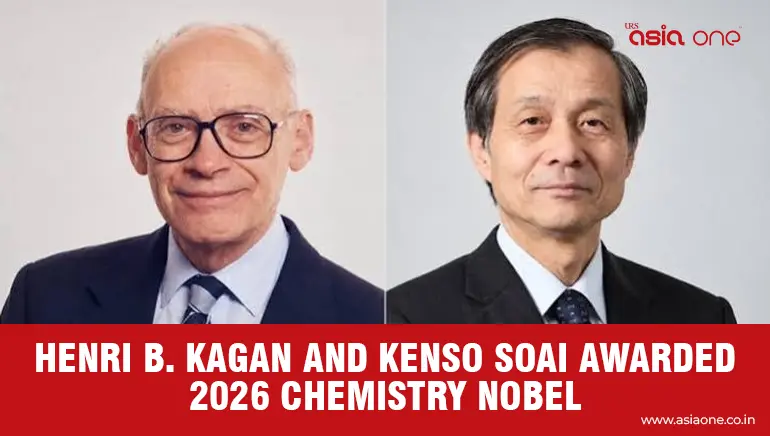
French chemist Henri B. Kagan and Japanese chemist Kenso Soai have been awarded the 2026 Nobel Prize in Chemistry for discoveries that helped explain how chemical reactions can produce one mirror-image form of a molecule rather than the other.
The Royal Swedish Academy of Sciences recognised their work on asymmetric organic synthesis, nonlinear effects and autocatalysis.
Molecules can exist as two mirror-image forms known as enantiomers. While they have the same chemical composition, the two forms can behave differently in biological systems. Producing a specific form is therefore important in areas such as pharmaceutical research.
Kagan developed methods of asymmetric synthesis that gave chemists greater control over which form was produced during a reaction. His work established new approaches for creating molecules with a specific configuration.
Soai later demonstrated asymmetric autocatalysis, in which a small initial difference between the two mirror-image forms can be amplified during a chemical reaction. His research showed that molecular asymmetry can be generated and reinforced through chemical processes without biological intervention.
The findings contributed to research into homochirality, the predominance of one molecular form in many biological systems. The Academy said the scientists’ work addressed how molecular asymmetry can arise and become amplified.
Kagan and Soai will share the 2026 Nobel Prize in Chemistry, which carries a total award of 12 million Swedish kronor.