



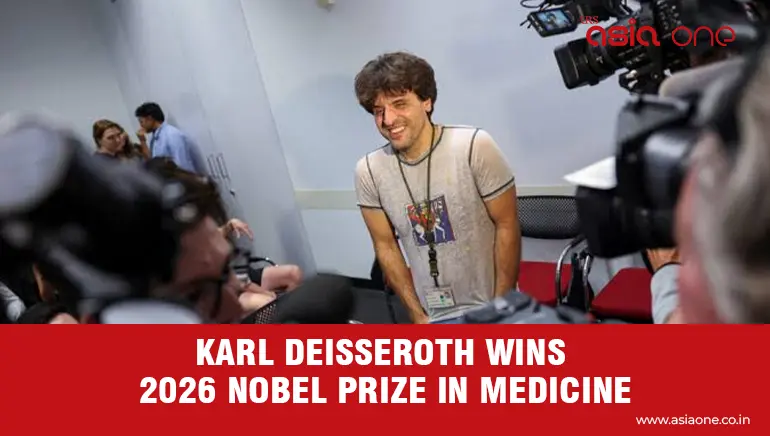
US scientist Karl Deisseroth has won the 2026 Nobel Prize in Physiology alongside German scientists Peter Hegemann and Georg Nagel. The trio was recognised for their discoveries involving light-gated ion channels and the development of optogenetics, a technique that uses light to control nerve-cell activity.
Hegemann and Nagel discovered light-sensitive proteins known as channelrhodopsins. Their research showed that light could control ion channels in cells. Deisseroth later developed methods that applied these discoveries to neuroscience, allowing researchers to control the activity of specific nerve cells using light.
Optogenetics has enabled scientists to investigate the functions of individual groups of neurons in living brains. The technique has been used to study neural circuits involved in movement, memory and behaviour.
Deisseroth is a professor of bioengineering, psychiatry and behavioural sciences at Stanford University and an investigator at the Howard Hughes Medical Institute. Hegemann is a professor at Humboldt University of Berlin, while Nagel is a professor at the University of Würzburg.
The Nobel Assembly said the discoveries had transformed research into how individual nerve cells function. By combining genetic methods with light-sensitive proteins, scientists can activate or silence selected neurons with greater precision than many earlier techniques.
The three laureates will share the Nobel Prize equally. The award was announced at the Karolinska Institute in Stockholm on October 4, opening this year’s Nobel Prize announcements.