



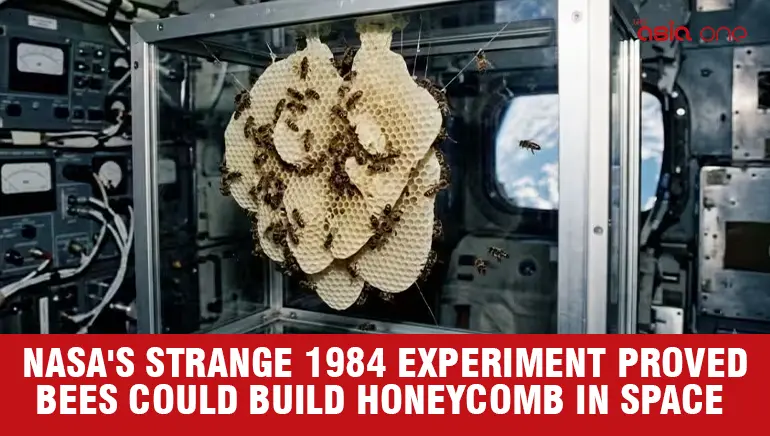
In April 1984, Space Shuttle Challenger carried around 3,300 honeybees into orbit for a student-sponsored NASA experiment.
The experiment tested whether bees could build honeycombs without gravity providing their usual directional reference.
The bees flew aboard STS-41-C, Challenger’s fifth mission, launched on April 6, 1984. The six-day mission deployed the Long Duration Exposure Facility and repaired the Solar Maximum Mission satellite.
The colony lived inside a specially designed Bee Enclosure Module built by Honeywell.
In microgravity, the bees successfully constructed around 200 square centimetres of honeycomb. The comb appeared essentially normal, showing that gravity was not essential for this fundamental behaviour.
The queen also laid around 35 eggs during the mission. However, none hatched, likely because of temperature-control problems inside the habitat.
The experiment demonstrated that basic honeybee colony behaviours could continue in weightlessness.
The Bee Enclosure Module was later reused for a housefly experiment aboard STS-51-D in 1985. Honeywell eventually donated the equipment to the Smithsonian’s National Air and Space Museum.