



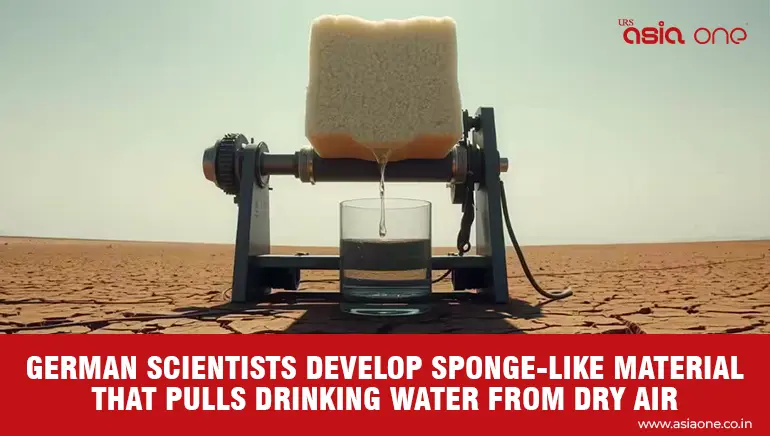
Researchers at Kiel University in Germany have developed a porous material called CAU-10-H that can capture water vapour from dry air and release it with relatively little energy. The material belongs to a class of compounds known as Metal-Organic Frameworks (MOFs), which work like molecular sponges by absorbing and releasing water molecules.
The research, led by Norbert Stock of Kiel University’s Institute of Inorganic Chemistry, was published in the Journal of Materials Chemistry A and Industrial & Engineering Chemistry Research. The team is exploring technology that can potentially produce drinking water in regions such as the Mediterranean, where rising temperatures and declining rainfall are increasing water stress.
Unlike many atmospheric water-harvesting materials, CAU-10-H technology can begin capturing moisture at room temperature when relative humidity reaches just 18%. The captured water can then be released by heating the material to around 70°C. This temperature could potentially be supplied using solar or waste heat.
Under dry conditions, the material can capture up to 0.17 grams of water per gram of material. Researchers estimate that a composite could produce 1.8 litres of water per kilogram of material a day.
The material could also have another application: cooling. CAU-10-H reportedly performs around three times better than silica gel in adsorption cooling systems and could potentially use waste heat from sources such as data centres or industrial equipment.
The researchers have now scaled production to around 30 kg, roughly 60 times larger than previous laboratory batches. The next step is testing the technology in real-world conditions.