

Boasting of a rich Buddhist culture and colonial architecture, and then stunning tourist attractions in the form of gastronomy, ancient temples, backpacking destinations, places of ancient & modern culture and history, trekking destinations, visiting hill tribes, spotting tigers and other wildlife, caves, waterfalls, plateaus and coffee, Lao People’s Democratic Republic is a great country of traditions, agriculture and wildlife.
By His Excellency Khonepheng Thammavong, Ambassador of Lao People’s Democratic Republic in Singapore
“LAOS IS CONSIDERED ONE OF THE FEW TRULY EXOTIC TRAVEL DESTINATIONS LEFT IN THE WORLD”
Though the economy of the Lao PDR depends heavily on investment and trade with its neighbours, Thailand, Vietnam, and, especially in the north, China, it has consistently grown through cross-border trade. In 2011, the Lao Securities Exchange began trading, and in 2012, the government of Laos began the creation of the Laos Trade Portal, a website incorporating all information traders need to import and export goods into the country. The growth of the economy has been consistent and trade with neighbours has improved, such as, in 2016, China became the biggest foreign investor in Laos’ economy, having invested US$8.935 billion since from 2005 to 2018, according to Ministry of Planning and Investment of Laos 2005–2018 report. Vietnam and Thailand remained the second- and the third-largest investors as they invested US$3.767 billion and US$3.118 billion respectively. Because of its dependence on agriculture, subsistence agriculture makes half of Laos’ GDP and provides 65.3% of employment as per 2015 figures. Rice dominates agriculture, with about 80 percent of the arable land area used for growing rice. Approximately 77 percent of Lao farm households are self-sufficient in rice. Several economic reforms have taken place and several rice varieties have been developed, which have increased the production by an annual rate of five percent between 1990 and 2005. With persistent improvement, Lao PDR achieved a net balance of rice imports and exports for the first time in 1999. Since 1995 the Lao government has been working with the International Rice Research Institute of the Philippines to collect seed samples of each of the thousands of rice varieties found in Laos.
FULL OF RESOURCES
Laos is rich in mineral resources and metallurgy is an important industry of its economy. The government has been consistently working towards attracting foreign investment so it may develop its significant deposits of coal, gold, bauxite, tin, copper, and other valuable metals. Laos’ water resources are abundant and coupled with its mountainous terrain, it is able to produce and then export large quantities of hydroelectric energy. A famous product of Laos is Beerlao, which is exported to many developed countries such as the US, the UK, Germany, Japan, South Korea, and also to neighbouring countries such as Cambodia, Thailand and Vietnam. Receiving foreign direct investments since 2003–04 in its mining industry, Laos has improved its economy significantly, and more than 540 mineral deposits of gold, copper, zinc, lead and other minerals have been identified, explored and mined. In 2018, the country ranked 139th on the Human Development Index (HDI), indicating medium development.
TOURISM OPPORTUNITIES
The growth in the tourism sector has been high, as from 1990 when 14,400 international tourists visited Laos, the figure increased to 4.1 million in 2018, and is expected to increase to 6 million by 2020. Now, Laos is expected to generate a minimum annual revenue of US$953 million by 2020. Export earnings from international visitors and tourism goods are expected to grow in nominal terms to US$484.2 million (12.5 percent of the total) in 2020. Being true to its official tourism slogan of “Simply Beautiful”, Laos boasts of several UNESCO World Heritage sites such as Luang Prabang and Wat Phu. Laos’ major festival includes Lao New Year (Boun Pi Mai Lao) celebrated in all provinces around 13–15 April, and main activities held during Lao New Year involves Ba Si or Soo Kwan, a beauty pageant, sand stupa building and water splasing each other. The Lao National Tourism Administration, related government agencies and the private sector are working together to realize the vision put forth in the country’s National Ecotourism Strategy and Action Plan. Laos is famous for silk and local handicraft products, which are available in Luang Prabang’s night market. It is also famous for mulberry tea. Considered one of the few truly exotic travel destinations left in the world, Laos takes you to an exciting journey of back-in-time with Buddhist temples and enigmatic heritage sites. The wonderful tourist destinations of Laos include the following:
Luang Prabang: It is a UNESCO World Heritage Site and a beautiful little town that features former royal palaces and more than 30 temples, old French colonial architecture as well as beautiful natural sites.
That Luang: That Luang, or the Great Stupa, in Vientiane is a national symbol (on Laos’ official seal) and is also the most sacred monument in the country. From the outside That Luang looks more like a fortress surrounded by high walls and it features two temples with the main stupa, the top of which is covered with gold leaf, standing 148 feet tall.
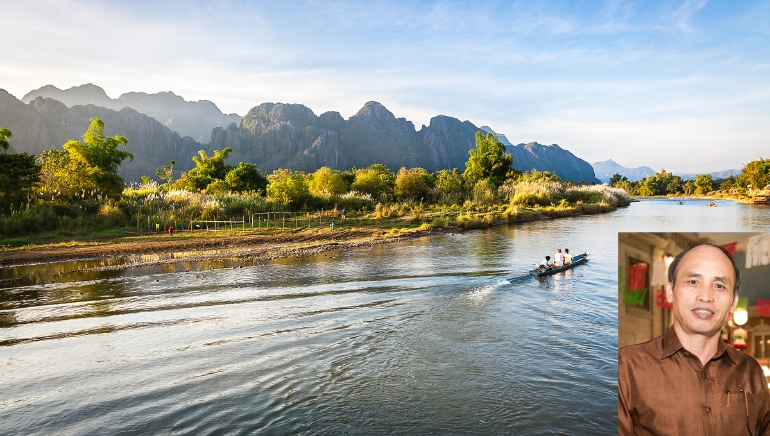
Vang Vieng: Surrounded by great mountains, rivers, limestone cliffs and rice fields, Vang Vieng is a small and scenic town that also includes the Nam Song River.
Wat Si Saket: It is famous for its cloister wall housing thousands of tiny Buddha images and rows with hundreds of seated Buddhas, dated from the 16th and 19th centuries and are made from wood, stone and bronze – more than 6,800 Buddhas in total.
Bolaven Plateau and Tad Fane Waterfall: It is famous for its great scenery, ethnic villages and unexplored corners, and holds some of Southeast Asia’s most spectacular waterfalls including Tad Fane and Dong Hua Sao, with the elevation ranging from 1,000 to 1,350 metres above sea level.
Bokeo: It is rich in natural resources with hilly mountains, tropical forest and farmland, and is home to many ethnic groups who still preserve their traditional lifestyles and culture.
Buddha Park (Wat Xieng Khuan): It is a famous park with more than 200 religious statues including a huge 40-metre high reclining Buddha image. It was built in 1958 by Luang Pu Bunleua Sulilat, a monk who studied both Buddhism and Hinduism.
The Plain Of Jars: Considered the most distinctive and enigmatic of all Laos attractions, it consists of a large area around Phonsavan, the main city of Xieng Khouang Province dotted with stone jars, carved from both sandstone and granite in various sizes, about which no one knows why they are placed there.
Wat Phu: It is a UNESCO World Heritage Site. It means mountain temple and is situated on a hillside, offering stunning views over the surrounding land and Mekong River. The magnificent workmanship done here includes temple pillars, barays, lintels, pediments, etc.