



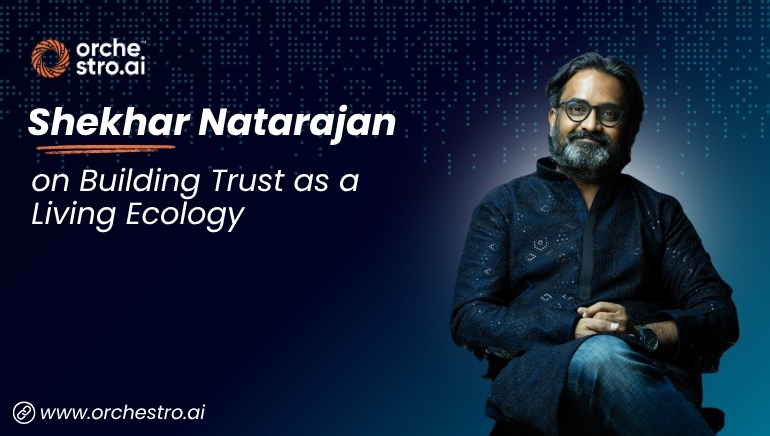
Intelligence has long been celebrated as the ultimate metric of technological progress, yet Shekhar Natarajan, Founder and CEO of Orchestro.AI, argues that sophistication without ethical grounding is dangerously incomplete. Across his extensive tenure in Fortune 500 companies, Shekhar has observed a consistent pattern that high-performing systems often maximise efficiency while systematically disregarding fairness. For him, efficiency alone cannot sustain societal or organisational confidence. His work in Angelic Intelligence asserts the idea that AI must elevate human values, instead of just executing instructions.
According to Shekhar, “The world does not need more intelligent machines. It needs machines we can trust.” His concept of Angelic Intelligence is a clarion call to redesign AI architecture itself. While today’s systems are extraordinarily capable, they remain largely amoral, with ethics often introduced as an afterthought. Shekhar reverses this order and places ethics at the very core, so that trustworthy behaviour can emerge naturally as intelligence scales. Without this foundation, intelligence risks becoming nothing more than sophisticated manipulation.
Shekhar speaks passionately of the Trust Ecology, a network of confidence between the AI system, its users, the deploying institutions and the wider society. When this holds, public services move faster and investment flows with ease. But when it fails, as seen in cases of opaque systems, progress stalls regardless of economic gains.
In critical sectors, he operationalises these principles through 27 Digital Angels. These specialised agents, inspired by the world’s ethical traditions, evaluate actions against virtues like compassion and accountability. Every decision receives a virtue-weighted score, with escalation for human judgment where needed.
At the organisational level, this ecology is shaped by leadership. The alignment between a leader’s values and actions sets the tone for everything that follows. Teams lacking integrity cannot produce trustworthy outcomes, no matter how advanced their technical capabilities. For Shekhar, ethical AI cannot exist in isolation; it is a reflection of conscious leadership. Technology mirrors culture, and culture reflects the values consistently practised at the top.
The consequences of ignoring ethics can spell disasters. Shekhar ensures that AI protects the most vulnerable, with explainable decisions and virtue-weighted overrides for high-stakes actions. This design safeguards both efficiency and trust, while proving that ethical AI is more resilient and sustainable at scale.
In the AI economy, Shekhar Natarajan reminds us that the future belongs to those systems and societies where trust is foundational. Ethical AI is not optional; it is the only way to ensure that progress benefits humanity, preserves dignity, and builds the Viksit Bharat India envisions.