

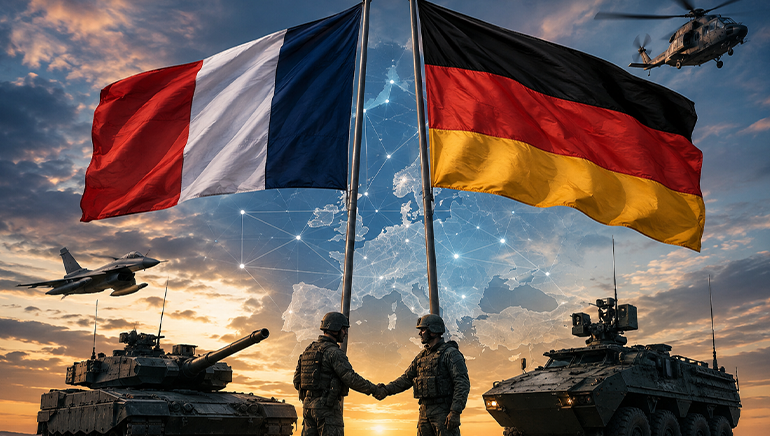
France and Germany have agreed to deepen defence cooperation, strengthen Europe’s military capabilities and coordinate efforts to address economic challenges posed by China, as both countries push for greater strategic autonomy amid shifting global security dynamics.
In a joint cabinet session in Bruehl, Germany, French President Emmanuel Macron and German Chancellor Friedrich Merz outlined plans to expand collaboration on missile defence, long-range strike systems and other defence initiatives. The leaders said the partnership will enhance Europe’s collective security while complementing NATO’s commitments.
The two leaders also criticised China’s unfair trade practices, including industrial overcapacity and extensive state support for domestic industries. Merz said Europe must engage in dialogue with Beijing while ensuring that European jobs and industries are protected from unfair competition.
France and Germany discussed nuclear deterrence cooperation. For the first time, German troops will participate in a French nuclear exercise, although Macron stressed that France would continue to finance and maintain full responsibility for its nuclear deterrent.
Despite the collapse of plans to develop a joint new fighter aircraft, both leaders confirmed that the Future Combat Air System (FCAS) programme will continue, progressing on its cloud-based information systems and other collaborative defence technologies. Macron said governance measures would be strengthened to improve future defence cooperation.
The renewed partnership reflects Europe’s broader efforts to build stronger defence capabilities as the region adapts to evolving geopolitical and security challenges.