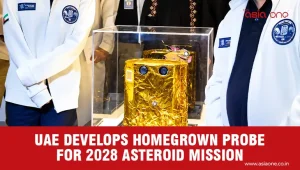


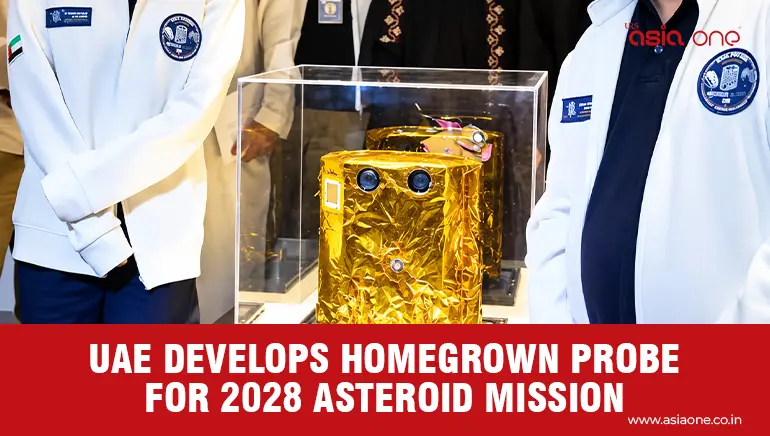
The United Arab Emirates has completed development of a locally built probe for its Emirates Mission to the Asteroid Belt, scheduled to launch in early 2028. The Technology Innovation Institute (TII) designed, assembled and tested the probe in Abu Dhabi before its planned integration with the MBR Explorer spacecraft in the United States.
The project involved the UAE Space Agency, technology company HEX20, Khalifa University and the UAE University’s National Space Science and Technology Center. It aims to strengthen the country’s domestic expertise in spacecraft engineering and deep-space exploration.
The spacecraft will travel approximately five billion kilometres to the main asteroid belt between Mars and Jupiter. It will use gravity-assist manoeuvres around Venus, Earth and Mars to reach its destination, reducing the amount of fuel required for the journey.
During the mission, the spacecraft will fly past six asteroids before attempting to rendezvous with and land on a seventh, 269 Justitia. The landing is planned for the later stages of the mission, following its launch in 2028.
Scientists hope the mission will provide new information about asteroid composition and planetary formation. Justitia is of particular interest because its properties could offer clues about the distribution of water and organic material in the early Solar System.
Developed by TII’s Propulsion and Space Research Center, the autonomous probe is the mission’s only deployable payload. The programme also seeks to expand opportunities for UAE-based businesses, with half of the mission’s work allocated to local private-sector companies.
The project builds on the UAE’s Emirates Mars Mission, whose Hope Probe entered Mars orbit in 2021. The asteroid mission marks a further step in the country’s efforts to develop its scientific and technological capabilities beyond Earth orbit.