



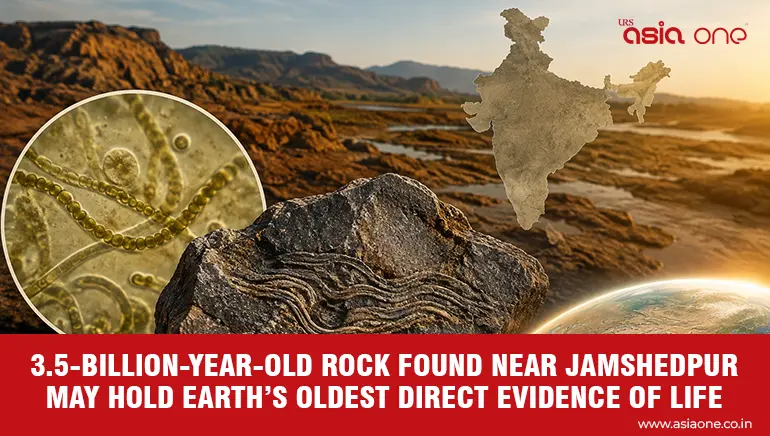
Researchers have identified a 3.5-billion-year-old carbon-rich rock near Jamshedpur, Jharkhand, that may preserve early evidence of life.
The chert was found near Bhitardari village in the Singhbhum Craton. Uranium-lead dating of zircon crystals placed the rock at roughly 3.497 billion years old.
Researchers identified alternating layers of silica and carbon-rich material. These resemble fossilised microbial mats formed by ancient bacteria and archaea on the seafloor.
Raman spectroscopy was used to analyse the carbon and compare it with younger graphite-bearing veins cutting through the rock.
If confirmed, the finding would place microbial activity around 1.1 billion years after Earth formed. The carbon signatures may indicate the presence of organisms capable of fixing carbon through primitive metabolic pathways.
The Singhbhum region also preserves evidence of ancient underwater volcanic activity. Such environments could have provided heat, minerals, and chemical energy for early microbial ecosystems.
However, researchers caution that ancient rocks can be heavily altered by heat, pressure, fluids, and deformation. Further studies will be needed to confirm the biological origin of the carbon.