


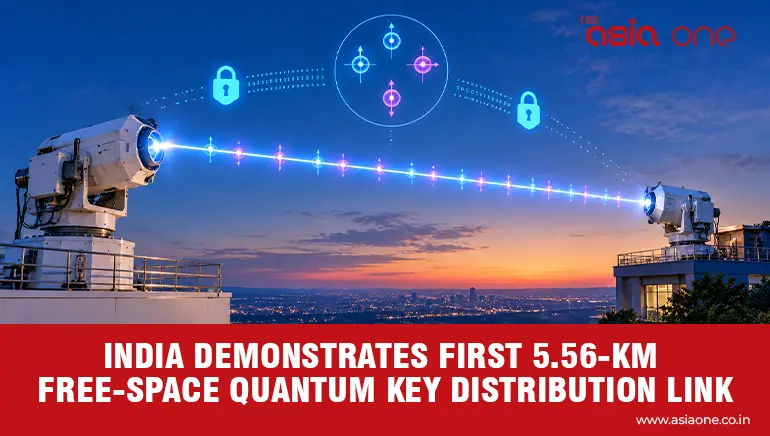
India has demonstrated its first free-space Quantum Key Distribution (QKD) link over a distance of 5.56 kilometres. The trial was conducted by QNu Labs with the Bhaskaracharya National Institute for Space Applications and Geo-informatics (BISAG-N) and IIT Gandhinagar.
The field trial took place on the night of September 27–28 in Gujarat. It established a secure quantum communication channel between BISAG-N and IIT Gandhinagar using a free-space optical link.
The system recorded a Quantum Bit Error Rate below 5 per cent and generated secure keys at a rate of 230–260 bits per second. The keys were integrated with BISAG-N’s Vedic Kavach platform, which uses post-quantum cryptography. Test messages were successfully encrypted and decrypted through the combined system.
QNu Labs used its Armos QKD device with a Pointing, Acquisition and Tracking system to maintain the optical connection between the two locations. BISAG-N’s Vedic Kavach added software-based post-quantum cryptography and quantum random number generation.
QKD distributes encryption keys using quantum properties of light. The free-space approach sends the quantum signals through the atmosphere instead of a fibre-optic cable.
The demonstration provides a field-tested model for quantum-secure communications where fibre connections are difficult to deploy. It also has potential relevance to satellite communication, where free-space optical links can connect locations without physical cables.
The trial follows a January 2026 memorandum of understanding between BISAG-N and QNu Labs covering quantum-resilient cybersecurity and technology transfer.
The government described the demonstration as a step towards longer-distance quantum-secure communication systems and future terrestrial and space applications