


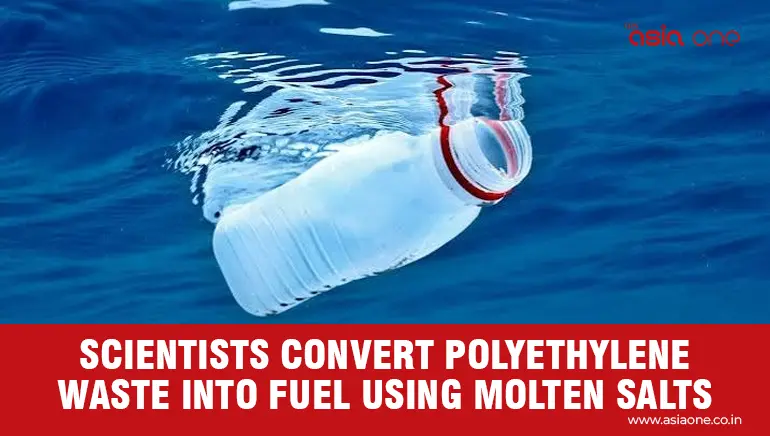
Scientists from Oak Ridge National Laboratory and the University of Tennessee have developed a process that converts polyethylene plastic waste into liquid hydrocarbons. The method uses molten salts containing aluminium chloride and sodium chloride.
The researchers found that the salt mixture can serve as both the reaction medium and the source of catalytic activity. It breaks down long polyethylene chains into smaller hydrocarbons that fall within gasoline and diesel ranges.
The process operates at temperatures below 170°C and does not require an external hydrogen supply. It also avoids added solvents and precious-metal catalysts. At 170°C, the researchers reported a total liquid-alkane yield of 63%, with the resulting hydrocarbons spanning gasoline through diesel fractions.
The reaction is driven by active aluminium sites in the molten salt, which have strong Lewis acidity. These sites help break carbon-carbon bonds and stabilise intermediate compounds as the plastic chains are transformed. X-ray methods, nuclear magnetic resonance and neutron scattering were used to examine the reaction.
The researchers also tested the process on more difficult plastic materials. High-molecular-weight compounds were successfully converted into liquid alkane products in the diesel range.
The research was published in the Journal of the American Chemical Society in 2025. Oak Ridge National Laboratory has since described the process as a potential way to handle difficult-to-recycle polyethylene and turn it into useful fuel and chemical products.
The approach offers a possible alternative to conventional plastic pyrolysis, which generally operates at much higher temperatures.