



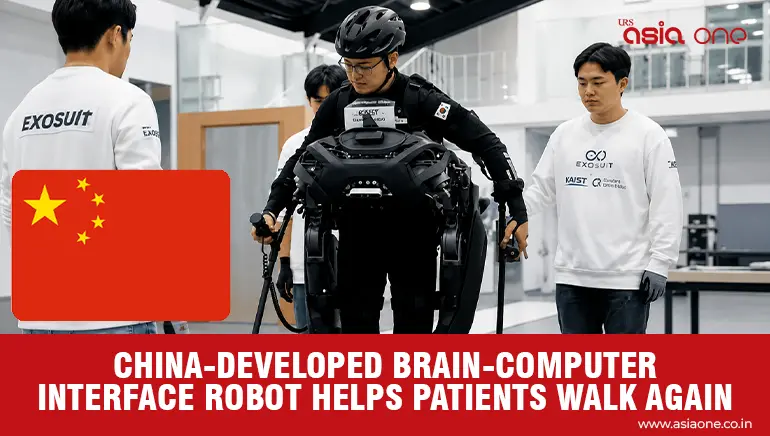
A China BCI exoskeleton robot is drawing attention for its ability to help patients regain movement through brain-computer interface technology. Developed by the Joint Laboratory for Universal AI in Disability Support in Hefei, the system combines non-invasive EEG signals, deep learning, and neuroplasticity principles to connect brain activity with assisted movement.
The BCI exoskeleton robot uses high-precision EEG sensors to detect brain signals. Through a technique known as motor imagery, the system identifies a patient’s intention to move and converts it into commands for the robotic exoskeleton. The device features a bionic structure designed to replicate human hip and knee joints. It also provides adaptive gait assistance and multi-level rehabilitation training.
The technology remains in research and development. According to the source, trials are currently taking place at more than a dozen hospitals in China. A formal project partnership is also underway with a provincial hospital in Anhui.
China has identified brain-computer interfaces as a future industry and included BCI development in its 15th Five-Year Plan for 2026–30. CCID estimates that China’s BCI market could reach 6.14 billion yuan by 2028, growing at a 17.7% compound annual rate from 2024.
However, despite rapid development and growing interest, BCI technology remains far from widespread commercial adoption.