


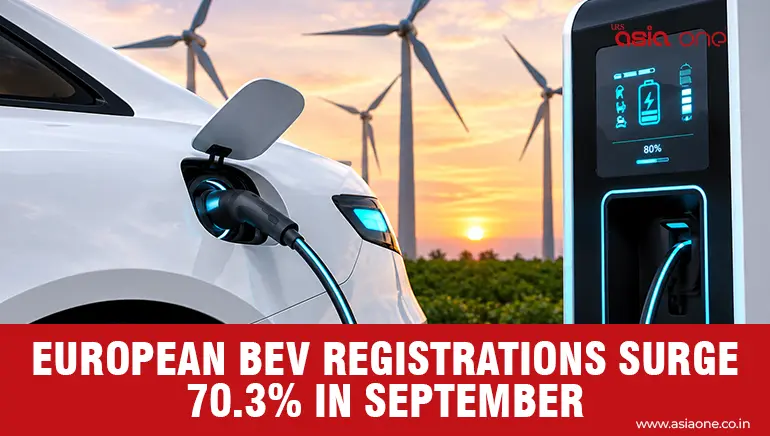
Battery-electric vehicle (BEV) registrations across 17 key European markets rose 70.3 per cent year-on-year in September, reaching 300,202 vehicles, according to data released by E-Mobility Europe, New Automotive and Fier Automotive.
Fully electric cars accounted for 32.6 per cent of registrations, equivalent to nearly one in three vehicles sold across the markets covered. Higher oil prices, government subsidies and the growing availability of more affordable models supported the increase.
Germany recorded 88,724 battery-electric registrations during the month, giving the vehicles a 34.6 per cent market share. France registered 65,243, with electric cars accounting for 41.7 per cent of its market.
The Nordic countries continued to lead Europe’s transition to electric mobility. Norway recorded a BEV market share of 98.8 per cent, followed by Denmark at 88.8 per cent. Finland and Sweden reported shares of 62.7 per cent and 49 per cent respectively.
Ireland, Portugal, Belgium and the Netherlands also saw battery-electric vehicles account for around half of registrations.
Across the 17 markets, 1.98 million BEVs had been registered during the first nine months of 2026, an increase of 38.1 per cent compared with the same period last year.
However, adoption remained uneven. The Czech Republic recorded an 11.2 per cent market share, while Italy and Poland reported 7.6 per cent and 6.2 per cent respectively.
The increase came as France and Germany agreed to soften proposed European Union emissions rules for cars, highlighting the ongoing debate over the pace of the region’s transition away from petrol and diesel vehicles.