



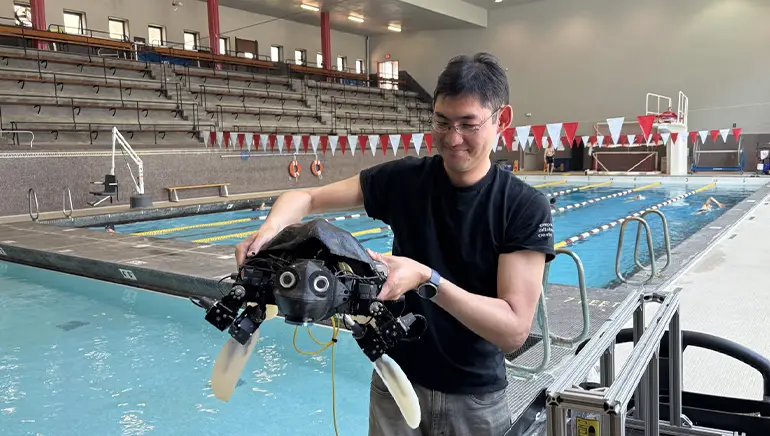
A 16-year-old student from Ontario, Canada, has developed an AI-powered robotic sea turtle capable of swimming autonomously, maintaining a preset depth and detecting microplastics in lakes and oceans. The innovation earned Evan Budz the $50,000 Gordon E. Moore Award for Positive Outcomes for Future Generations at the 2026 Regeneron International Science and Engineering Fair (ISEF).
The idea was inspired by a snapping turtle Budz observed during a family camping trip in Ontario. After spending nearly 4,000 hours designing and refining the project, he created a robotic turtle equipped with an underwater holographic camera that can distinguish microplastics from aquatic organisms.
The robot features 3D-printed flippers, a custom multi-axis servo mechanism and a streamlined spherical front that reduces drag by 65% to mimic the swimming motion of sea turtles. It also uses a variable ballast system, pressure sensors and a 9-axis inertial measurement unit to control buoyancy, maintain depth and navigate autonomously.
The robot’s holographic imaging system, combined with artificial intelligence, can detect particles as small as 10 microns and identify microplastics with 94% accuracy. Unlike conventional testing methods that require laboratory analysis and can take days, the robotic turtle analyses water in real time as it moves.
Budz developed the technology to address the growing challenge of plastic pollution, with millions of tonnes of plastic entering the world’s oceans every year. He plans to use the scholarship to pursue a university degree in science or engineering, while continuing to develop technologies that support environmental conservation.