


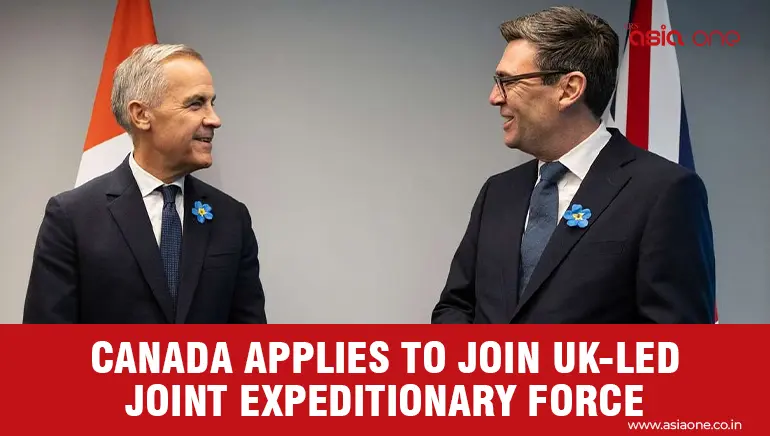
Prime Minister Mark Carney announced Canada’s formal application to join the UK-led Joint Expeditionary Force (JEF) after meeting British Prime Minister Andy Burnham in Liverpool on September 16. The meeting was held during Carney’s visit to the UK, with the two leaders discussing closer defence, security and economic cooperation.
The JEF currently has 10 NATO members, with the UK serving as its framework nation. The other members are Denmark, Estonia, Finland, Iceland, Latvia, Lithuania, the Netherlands, Norway and Sweden. The force was established in 2014 and focuses particularly on security across the High North, North Atlantic and Baltic Sea regions.
The JEF is designed to operate as a flexible and rapidly deployable force rather than as a permanent standing formation. Its members can participate in individual operations according to their national decisions, while the group can also support wider NATO or international missions.
Carney welcomed British support for Canada’s application. The leaders also discussed defence-industrial cooperation through the Global Combat Air Programme, which Canada joined as an observer in July 2026.
Their talks also covered the BATUS Future Project. Canada and the UK are working towards a new permanent arrangement to modernise British Army Training Unit Suffield at CFB Suffield in Alberta. The project is intended to develop the facility as a site for testing new military equipment and advanced technology.
The two governments also agreed to deepen cooperation on frontier technologies, including the safe and responsible development and use of artificial intelligence. Canada’s application now moves into the JEF membership process.