



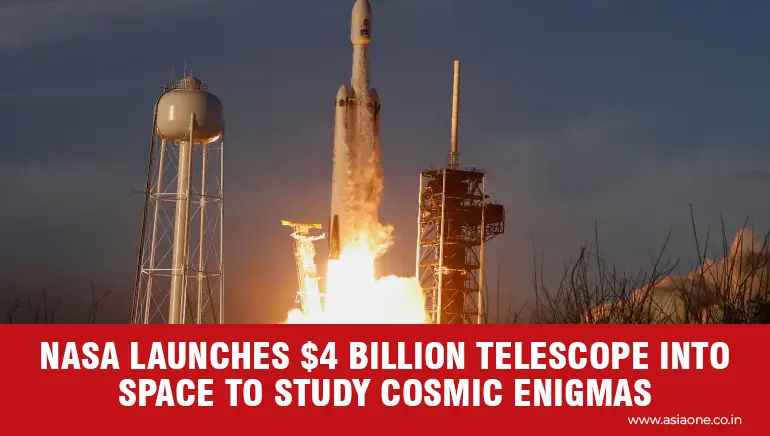
Nancy Grace Roman Space Telescope begins five-year mission to investigate dark energy, dark matter and distant worlds
NASA has launched the Nancy Grace Roman Space Telescope, a $4 billion space observatory designed to investigate some of the biggest unanswered questions about the universe.
The telescope was launched from Cape Canaveral aboard a SpaceX Falcon Heavy rocket and is now travelling towards Lagrange Point 2, located roughly one million miles from Earth. The mission is expected to operate for at least five years, with the possibility of an extension.
Named after NASA astronomer Nancy Grace Roman, the observatory will focus on understanding dark energy and dark matter, two major components of the universe that remain poorly understood. It will also search for distant exoplanets and study how galaxies and other cosmic structures have developed over time.
One of Roman’s major advantages is its exceptionally wide field of view. The telescope is designed to complement existing observatories such as Hubble and the James Webb Space Telescope. Its telescope can survey large portions of the sky much faster than the Hubble Space Telescope, allowing scientists to collect vast quantities of astronomical data. While Webb is particularly suited to detailed observations of individual objects, Roman will survey much larger areas of the sky. NASA expects the mission to help create one of the most detailed three-dimensional maps of the universe.
Scientists also expect the mission to identify thousands of previously unknown exoplanets and provide new information about the expansion and composition of the universe. The launch marks a major addition to NASA’s space-observation programme and could provide researchers with new evidence about the fundamental forces and objects shaping the cosmos.