


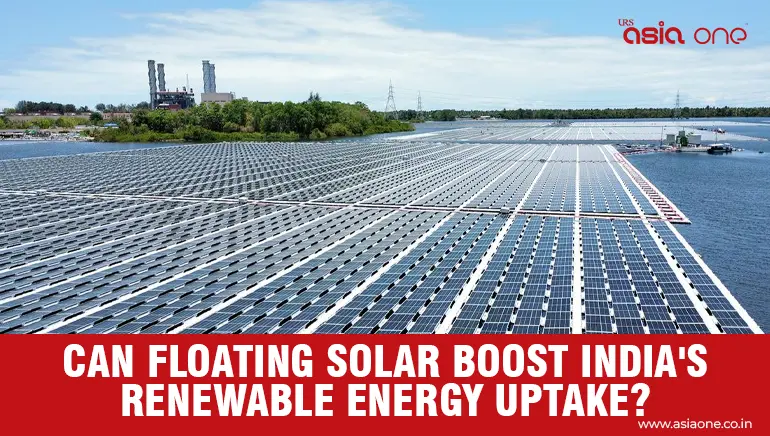
The Pradhan Mantri Surya Sarovar Yojana (PM-SSY) marks India’s biggest push towards floating solar development, with the Union Cabinet approving the scheme on July 31, 2026. Implemented by the Solar Energy Corporation of India (SECI), the central-sector programme aims to develop 5,000 MW (5 GW) of floating solar projects on reservoirs, industrial ponds, and inland water bodies by FY 2030-31.
The floating solar scheme has a government outlay of ₹5,070 crore and offers Central Financial Assistance of up to ₹1 crore per MW after project commissioning. Every project must also include a co-located Energy Storage System (ESS)with at least two hours of storage, helping states manage peak electricity demand while improving grid stability.
India currently has around 700 MW of installed floating solar capacity, despite an estimated 102.18 GW of technical potential across reservoirs and inland water bodies. Floating solar offers several advantages over conventional projects by conserving land, reducing water evaporation, and improving electricity generation through the cooling effect of water on solar panels.
The government expects the scheme to mobilise around ₹28,500 crore in total investment, reduce nearly 10 million tonnes of carbon dioxide emissions annually, and generate 16,000–17,000 full-time equivalent jobs. It is also expected to strengthen domestic manufacturing of floating structures, solar modules, and energy storage systems.
The floating solar initiative complements India’s broader renewable energy expansion. As of June 30, 2026, the country had installed 162.15 GW of solar capacity, up from about 3 GW in 2014, while total non-fossil fuel capacity reached 283.46 GW. With vast untapped potential and supportive policies, floating solar could become a key pillar of India’s clean energy transition.