



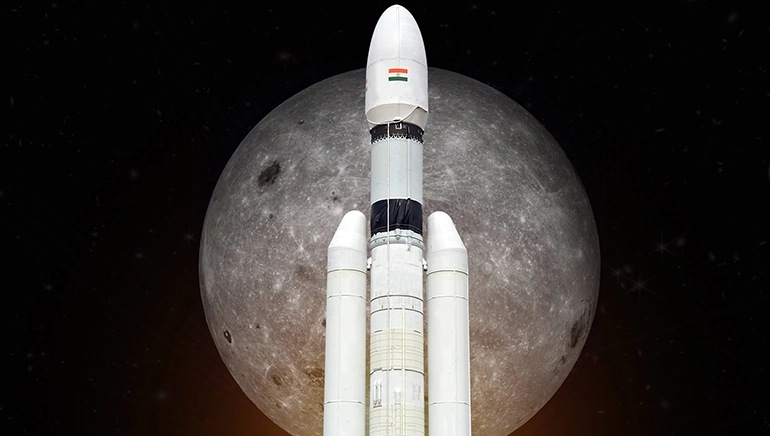
ISRO’s Chandrayaan-3 mission has uncovered new evidence linking the Moon’s south polar region to Earth’s first identified lunar meteorite, offering fresh insights into the Moon’s geological history and the composition of its crust.
Published in the journal Nature, the study analysed samples collected by the Chandrayaan-3 mission and found that rocks in the Moon’s south polar region contain material originating from multiple layers of the lunar crust. Scientists say the findings provide a clearer picture of how the Moon evolved over billions of years.
Researchers identified similarities between the composition of rocks examined by Chandrayaan-3 and that of Northwest Africa (NWA) 16286, the first lunar meteorite discovered on Earth, believed to have originated from the Moon’s south polar region.
The study suggests the Moon’s south pole preserves a complex geological record shaped by ancient asteroid impacts, volcanic activity, and large-scale mixing of crustal material. According to scientists, these processes exposed rocks from both the upper and deeper layers of the lunar crust, creating a diverse geological landscape.
Scientists believe the discovery strengthens the scientific significance of the Chandrayaan-3 mission, which became the first to achieve a successful soft landing near the Moon’s south pole in August 2023. The findings are expected to improve understanding of lunar evolution while helping researchers identify the origins of other lunar meteorites found on Earth.
Researchers added that studying these ancient rocks could provide valuable clues about the early history of the Moon and the processes that shaped planetary bodies across the Solar System.