


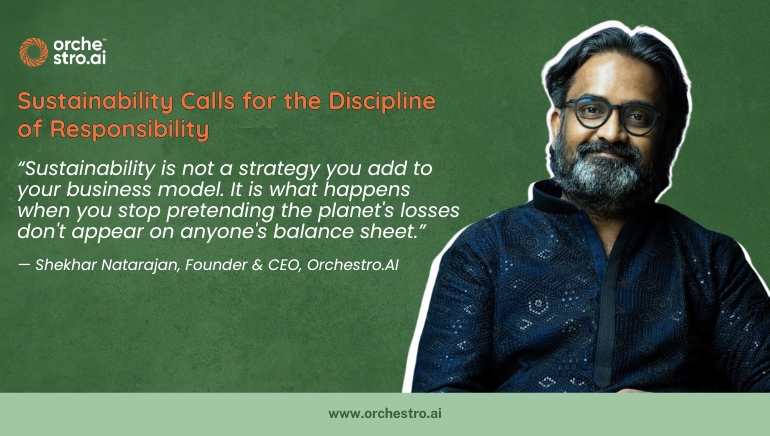
“Sustainability is not a strategy you add to your business model. It is what happens when you stop pretending the planet’s losses don’t appear on anyone’s balance sheet.”
— Shekhar Natarajan, Founder & CEO, Orchestro.AI
Sustainability is often spoken of as an additional layer in business, a separate department, or a reporting exercise placed at the end of the financial year. This understanding is deeply flawed. Sustainability is not an external commitment that organisations choose to adopt when convenient. It is the natural outcome of a system that recognises the true cost of its actions on resources, communities, and the future!
The modern economic model has normalised a dangerous separation. Profit is measured precisely, but loss to the planet is often treated as invisible. Food wasted across supply chains, fuel burnt in half-loaded transport, and inefficient logistics networks are not merely operational gaps; they are symptoms of a deeper moral oversight. When nearly 40% of food produced never reaches consumption, the issue is not scarcity but mismanagement. When goods move inefficiently across regions, the burden is silently transferred to the environment.
This is where intelligent systems play a critical role. Artificial intelligence, when designed with ethical intent, brings visibility where there was opacity. It connects fragmented parts of the supply chain, aligns demand with supply, and reduces inefficiencies that were earlier accepted as inevitable. The significance of such optimisation lies not only in cost reduction but in responsibility. Each avoided kilometre of transport, each optimised load, and each prevented instance of waste represents a direct reduction in environmental harm.
However, technology alone cannot deliver sustainability unless it is guided by accountability. Data must not remain confined to dashboards; it must inform decisions in real time, making every stakeholder aware of the environmental consequences of their actions. When sustainability metrics become as immediate and measurable as financial ones, behaviour begins to change. Consequently, responsibility becomes operational, not rhetorical.
There is also a deeper dimension. Sustainability demands a shift in mindset from local optimisation to systemic thinking. Businesses often optimise for their own efficiency while ignoring the larger network within which they operate. This leads to global inefficiency. Ethical AI corrects this by enabling coordination across the ecosystem and ensuring that decisions made in one part do not create loss elsewhere.
In this light, sustainability is not simply a choice but a moral correction. It is about acknowledging that economic activity cannot be separated from its impact on the planet. When systems are designed to account for this impact at every step, sustainability emerges as a natural consequence.
The future of responsible growth lies not in adding sustainability as an afterthought, but in building systems where waste, inefficiency, and environmental harm are no longer acceptable outcomes.
The same philosophy finds practical expression in the work being carried out by Mr. Shekhar Natarajan through his brainchild, Orchestro.AI, driven by Angelic Intelligence and its 27 Digital Angels. These value-driven agents ensure that technology does not operate in isolation, but with a sense of responsibility, while helping reduce inefficiencies and maintaining fairness in decision-making.