


The Alchemist of Algorithms
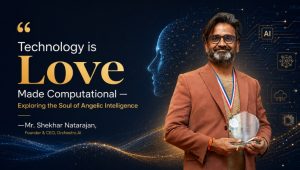
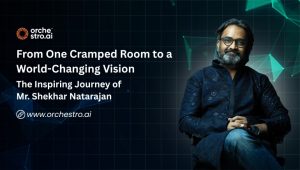
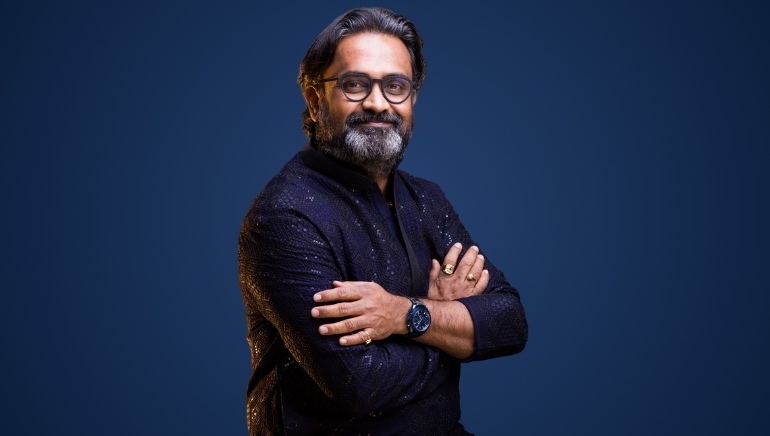
Shekhar Natarajan, the Founder and CEO of Orchestro.AI, is not merely building another software unicorn but attempting an architectural overhaul of the moral foundation of technology. His concept of “Angelic Intelligence” aims to elevate artificial intelligence from a servant of productivity to a guardian of human dignity, while heralding positive change on a global scale
“BUILD WITH LOVE. BUILD FOR THE LONG ARC. THE MARKET HAS NO CONSCIENCE — THAT IS EXACTLY WHY WE EXIST”
Shekhar grew up in modest circumstances, where daily life revolved around simple necessities. His early years taught him the value of persistence long before he encountered patents or boardrooms. He imbibed his values from his mother, who, seeking a better future for her son, stood outside the school office every day, for an entire year, pleading with authorities to enrol her son. Rain or shine, she persisted, with her unbroken patience and determination. She even pawned her wedding ring for 30 rupees to fund his education. Her resilience instilled in young Shekhar the understanding that values are not inherited but earned through steady action.
FROM MODEST ROOTS TO GLOBAL LEADERSHIP
Shekhar’s path was not paved by privilege. He pursued education with the same resolve his mother had shown. Later, his academic journey took him to institutions such as Georgia Tech, MIT, Harvard Business School, and IESE. The exposure and opportunity he received during his academic journey sharpened his technical abilities and expanded his view of the world.
But the deeper lessons, he often reflects, came from elsewhere. They came from observing how people respond to adversity, how integrity holds up under pressure, and how judgment is formed over time. He sought out mentors who did not simply endorse his thinking, but questioned it. That habit of engaging with criticism without being overwhelmed by it became an important part of his approach. It helped him separate insight from noise, and conviction from stubbornness.
Over the years, he accumulated 207+ patents and held leadership roles across global technology firms. Yet he never considered technical excellence as an end in itself. Every patent and project reinforced his belief that technology without moral direction is incomplete. This conviction inspired him to establish Orchestro.AI, not as just another AI venture chasing scale or market share, but as a purposeful initiative to integrate human values and responsibility into the architecture of intelligent systems.
THE BIRTH OF ANGELIC INTELLIGENCE
As Founder and CEO of Orchestro.AI, Shekhar began redefining what intelligent systems could be. He called his framework Angelic Intelligence. Its role is to ponder not what AI can do but what AI should do. In a time when algorithms drive decisions at a massive scale, this framework places dignity, fairness, and trust ahead of every design choice. It does not supplant current AI but guides it like a mentor. Its goal is to ensure that efficiency serves people rather than the other way around.
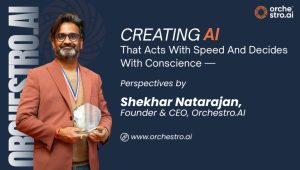
To make ethics operational, Shekhar introduced the 27 Digital Angels. These are specialised AI agents, each embodying a core human value—compassion, justice, accountability, discernment and others drawn from universal principles. Before any major output is generated, the agents evaluate the proposed decision against their respective criteria. The result is a value weighted assessment. If a decision falls below ethical thresholds, it is automatically escalated for human review. Here, automation handles execution and humans retain the power to set boundaries. Moral responsibility stays where it belongs—with people.
This approach does not diminish human judgment but elevates it. In high-stakes areas such as healthcare and governance, a flawed diagnostic tool can spell disaster. Angelic Intelligence flags such risks early and demands transparency.
Two principles drive the Angelic Intelligence framework. First, explainability is treated as a basic right. Anyone affected by a decision must understand it in clear terms, not technical jargon. Second, virtue weighted override ensures that ethically questionable outputs are flagged for human intervention, regardless of the system’s confidence level. In governance applications, a third principle—humility—is added to guarantee that AI supports democratic processes rather than bypassing them.
Shekhar’s vision draws inspiration from India’s civilisational heritage. Ancient philosophies and the moral leadership of figures like Mahatma Gandhi have long offered guidance on ethical conduct. As a values-driven leader, he believes that India’s time has come to go beyond being just a moral voice.
In the age of AI, India can become a global leader in ethical technology. While speed and scale are important, wisdom is even more crucial to stand out. Shekhar argues that India is uniquely positioned to show that true technological leadership can grow from strong values, not just from the amount of data or rapid expansion.
RETHINKING DEVELOPMENT
Shekhar’s vision resonates deeply with India’s Viksit Bharat @2047 vision. He challenges the assumption that development is measured only by GDP or infrastructure. Real progress, he says, lies in ensuring every citizen, whether a farmer in Telangana or an investment banker in Mumbai, receives fair and respectful treatment from the systems that shape their lives. Initiatives like Digital India, Atmanirbhar Bharat and the National AI Strategy provide the hardware and policy backbone. Yet, he points out that without a moral architecture, even the most efficient systems risk becoming unjust. Angelic Intelligence supplies that missing layer by instilling ethical reasoning into the design itself, not as an afterthought.
HIS UNIQUE IDEA OF TRUST
One of his significant contributions lies in how he conceives trust. He outlines a “Trust Ecology,” where trust emerges not by chance but by design. Every technological system, he maintains, dwells within a network of relationships binding individuals, institutions, and society.
Trust, in this sense, operates at multiple levels. It begins with the reliability of individual decisions, grows through repeated interactions, and ultimately shapes how society views technology as a whole.
If trust weakens at any stage, the effects are not contained. They spread across the system. Much of today’s technology, he points out, remains focused on immediate outputs. The longer-term question of trust often receives less attention.
ETHICS AS EFFICIENCY
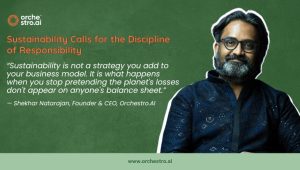
Shekhar rejects the notion that ethics and efficiency are at odds. Systems built on fairness and accountability, he observes, actually perform better over the long term. They commit fewer serious errors, retain user confidence and avoid the heavy costs of reputational damage or regulatory failure. Ethical AI is not slower; it is more reliable and durable. This thinking extends to sustainability. Global supply chains waste food and underutilise transport not merely through inefficiency but through ethical blind spots. Orchestro.AI applies Angelic Intelligence to create end-to-end visibility and coordination, reducing waste while embedding responsibility into daily operations rather than treating it as a separate CSR exercise.
PERSONAL ANCHORS IN LEADERSHIP
Shekhar views an organisation’s external culture as a direct reflection of its leaders’ inner state. He begins each day with classical Indian painting, an exercise that requires patience, focus, and complete presence. This ritual helps him settle his thoughts before stepping into the demands of the day.
When faced with difficult choices, he relies on what he calls the “thousand-year test.” He weighs decisions not just for immediate outcomes, but for the lasting value they might hold far into the future. It is a way of distancing himself from short-term pressures and anchoring his thinking in something more enduring.
He is equally clear about how to deal with scepticism. Not all doubt, he says, is the same. He regards this as necessary, even valuable, because it prevents complacency and sharpens thinking. It is the kind of resistance that improves the work rather than obstructs it.
Learning, for Shekhar, has never been confined to formal spaces. While institutions such as MIT and Harvard shaped his thinking, some of his deepest lessons came from observing ordinary people navigate life with honesty and resolve. In the end, he values what is lived and demonstrated over what is merely taught.
DRIVEN BY PURPOSE
Shekhar is not chasing the next valuation milestone. Instead, he is focused on building technology powered by trust, dignity, and accountability. He believes that true wealth lies in wisdom, and that technology should reflect human values. For him, trust is not a feature to promote, but something that must be consistently nurtured. As AI becomes more integrated into everyday life, frameworks like Angelic Intelligence will be increasingly important. India, with its blend of ancient wisdom and modern technological strength, is well positioned to lead this shift. Through Orchestro.AI, Shekhar is not just part of the conversation, he is helping shape it. In a world driven by speed and scale, his approach stands out for its strong sense of purpose and responsibility.