


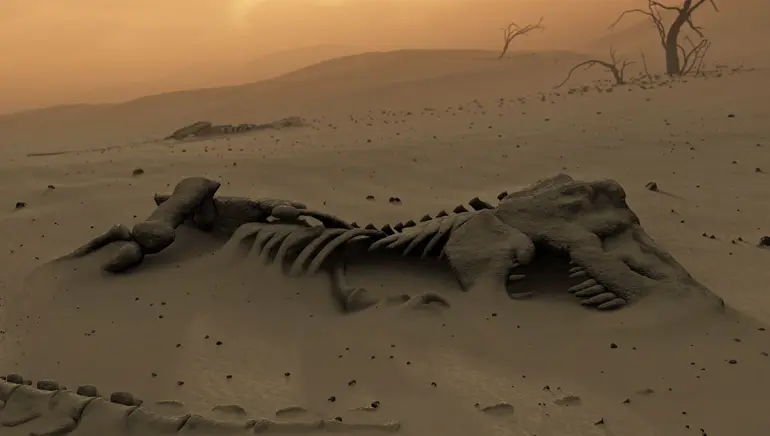
A newly discovered species of dinosaur in Zimbabwe has provided scientists with important new clues about the early evolution of dinosaurs in southern Africa. Named Musango matutodonensis, the 4.5-metre-long dinosaur is the fifth species identified from the African country.
The fossil was discovered along Lake Kariba in Zimbabwe and dates to approximately 210 million years of Late Triassic period. The discovery was made through a collaborative effort involving researchers from the United Kingdom, South Africa, and Zimbabwe, highlighting the region’s rich but understudied fossil record.
Scientists believe the dinosaur was around eight years old when it died and would have measured roughly 4.5 metres in length, comparable to the size of a medium-sized car. The study suggests it was likely an omnivore, feeding on both plants and meat.
Researchers identified the animal as a sauropodomorph, an early relative of giant long-necked dinosaurs such as Diplodocus. Unlike its later descendants, it walked on two legs rather than four. Fossils recovered from the site, including bones from the spine, arms, and feet, indicate that the dinosaur was almost fully grown at the time of its death.
The surrounding fossil deposits contained remains of crocodile-like phytosaurs, lungfish, and other small dinosaurs, offering a broader picture of the ecosystem in the ancient supercontinent Gondwana, which included present-day South America, Africa, India, Australia, and Antarctica.
Researchers said the discovery demonstrates that ancient Africa consisted of diverse ecosystems rather than a single uniform environment, providing valuable insights into dinosaur evolution and prehistoric biodiversity.