



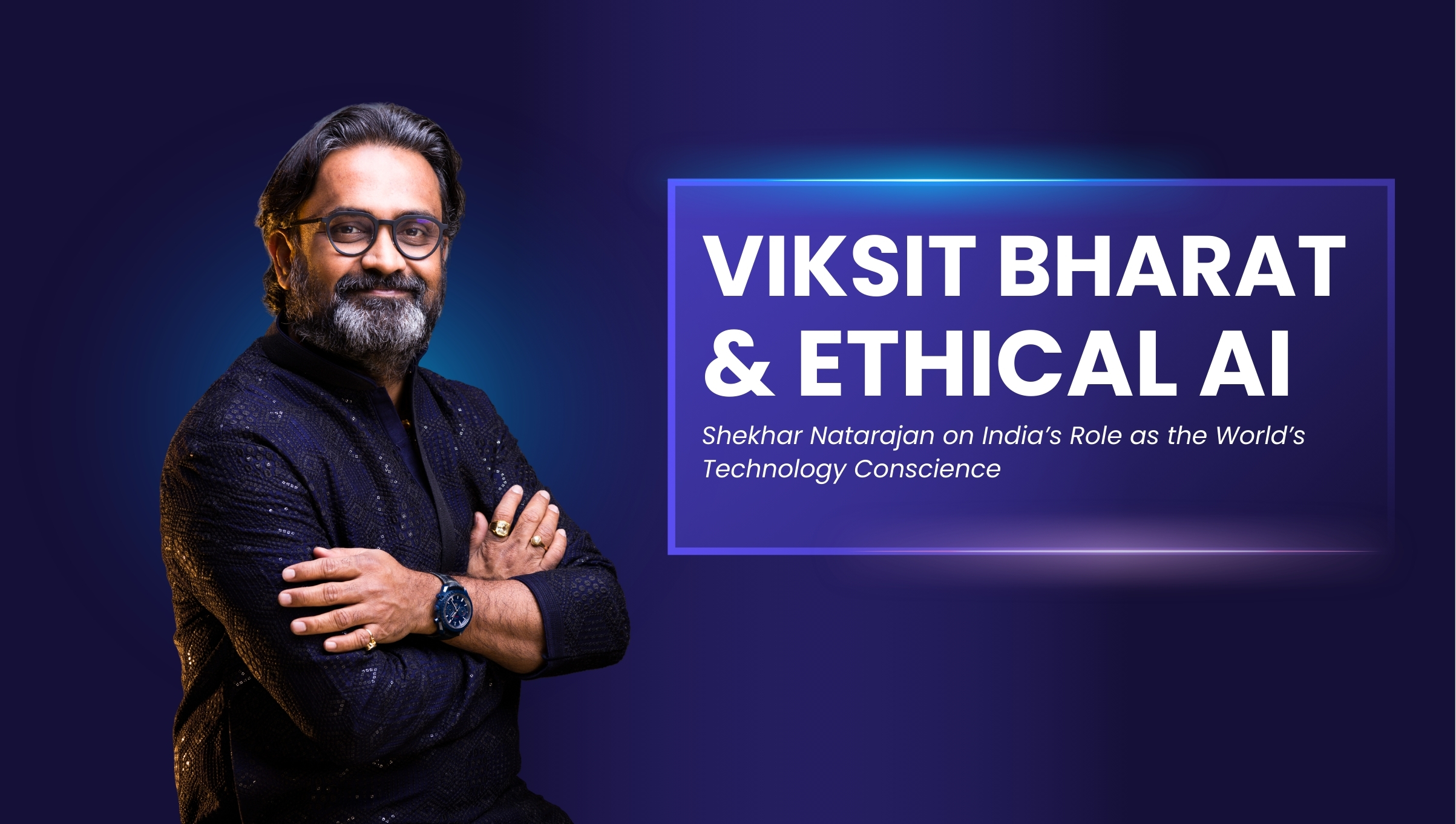
When the world talks about artificial intelligence, speed, efficiency, and profitability often dominate the conversation. But Mr. Shekhar Natarajan, Founder and CEO of Orchestro.AI, urges a pause. For him, India has a unique opportunity; not merely to adopt global AI, but to offer a model of AI imbued with moral clarity. “India has always been the world’s moral compass,” says Shekhar Natarajan. From the wisdom of the Upanishads to Gandhi’s triumph through truth, India’s strength has been ethical grounding. Now, he believes, the nation can carry that conscience into the realm of technology.
Mr. Natarajan presents the concept of Angelic intelligence as a framework that aims to enhance human virtues such as fairness, dignity, empathy, and wisdom. Unlike traditional AI that retrofits ethics after the fact, Angelic intelligence embeds virtue at the very core of computation. “Ethics is not a brake on the machine; it is the engine design,” Mr. Natarajan explains. This principle forms the backbone of a national Trust Ecology—a system where citizens trust institutions, institutions trust data, and AI systems are trustworthy by design.
For Mr. Natarajan, the vision of Viksit Bharat extends beyond GDP. True development is about empowering every citizen with fairness and dignity. Farmers in Telangana and fund managers in Mumbai should experience the same ethical treatment from AI systems. Through Orchestro.AI, he is operationalising this vision with 27 Digital Angels, which are AI agents that evaluate every decision against virtue criteria drawn from diverse ethical traditions. The result is AI that does not just act efficiently but acts rightly.
Mr. Natarajan insists that ethical AI and efficiency are not mutually exclusive. A system designed to respect dignity reduces errors, maintains trust, and proves more resilient. In healthcare, governance, and supply chains, this approach prevents catastrophic failures that disproportionately affect the vulnerable. For him, India’s moral and technological advantage lies in producing AI that the world can trust—a model where real development and ethical intelligence advance together.
The contrast between Angelic Intelligence and today’s conventional AI systems is visible in the decisions they make and the reasoning behind them. A current AI system optimizing a loan approval process, for instance, will approve or reject based on statistical risk alone—efficient, but blind to the dignity of the individual sitting on the other side of the screen. An Angelic system asks a different set of questions: Is this outcome fair? Does it preserve the applicant’s sense of worth? Would a virtuous human being be proud of this decision? Where a conventional AI in a healthcare supply chain might deprioritize a rural clinic because its order volume is low, an Angelic system recognizes that low volume often signals the most vulnerable population—and weights its response accordingly. In content moderation, today’s AI flags and removes based on pattern-matching; Angelic Intelligence considers context, cultural nuance, and the human cost of being wrongly silenced. The difference, at its core, is that conventional AI is designed to win an outcome, while Angelic Intelligence is designed to deserve one.
“Real wealth is wisdom. Real technology is love made computational. Real trust is an ecology—and we are its gardeners,” reflects Shekhar Natarajan. In his vision, India does not just participate in global AI; it defines what it ought to be.